
Ayodhya, one of India’s most ancient and revered cities, holds a unique place in the cultural and spiritual landscape of the country. Celebrated in the Ramayana and countless historical texts, it is widely believed to be the birthplace of Lord Ram, the seventh incarnation of Lord Vishnu and one of the most cherished deities in Hindu tradition. Over centuries, Ayodhya has remained a symbol of devotion, faith, and India’s rich mythological heritage. The site known today as Shri Ram Janmabhoomi has been at the heart of this cultural identity, making the Ram Mandir Ayodhya not just a structure of worship but a landmark of immense emotional and religious significance.
The Ayodhya Ram Mandir stands as a testament to centuries of belief intertwined with complex historical events. The Ram Mandir history spans ancient scriptures, medieval accounts, archaeological findings, legal battles, social movements, and ultimately, a historic Supreme Court verdict that paved the way for the construction of the temple. This intricate past and its transformation into a modern architectural marvel reflect India’s evolving cultural consciousness and respect for its ancient roots.
The purpose of this blog is to present a comprehensive, easy-to-understand narrative of the complete journey of Ram Mandir—from its earliest references in sacred texts to the long-standing dispute, from archaeological discoveries to the Supreme Court judgment, and finally to its majestic construction and inauguration in the 21st century. By exploring the timeline, historical context, and cultural relevance, this article aims to offer readers a clear understanding of how the Ram Mandir evolved from a sacred belief to a monumental reality in Ayodhya.
Ancient Ayodhya: Mythology, Scriptures & Early References
Ayodhya in the Ramayana
The earliest and most significant references to Ayodhya come from the Valmiki Ramayana, one of India’s oldest and most revered epics. Composed thousands of years ago, the Ramayana describes Ayodhya as the magnificent capital of the Ikshvaku dynasty, ruled by King Dasharatha, father of Lord Ram. The epic portrays Ayodhya as a city of unparalleled prosperity, harmony, and architectural grandeur—often referred to as the “city built by the gods.”
Within this ancient narrative, Ayodhya is firmly established as the birthplace of Lord Ram, making it a sacred center of worship and pilgrimage for millions of devotees for millennia. The epic’s Balakanda provides detailed genealogies and descriptions of the city, emphasizing its divine association and cultural richness. These references form the foundational layer of Ayodhya mythology and continue to shape its religious identity to this day. For believers, the sanctity of Shri Ram Janmabhoomi is not merely historical—it is deeply embedded in spiritual memory and cultural continuity.
Archaeological & Scriptural Mentions
Beyond the Ramayana, Ayodhya’s prominence is reinforced through multiple ancient scriptures, historical texts, and archaeological insights. The Skanda Purana and Atharva Veda both mention Ayodhya as a revered and prosperous city, highlighting its spiritual significance long before the medieval period. The Atharva Veda even refers to Ayodhya as a city “fit for the gods,” strengthening its ancient reputation as a sacred geography.
Ayodhya’s influence is not limited to Hinduism alone. Early Buddhist and Jain texts also reference the city as an important cultural and spiritual hub. Buddhist chronicles mention the region as part of the Kosala kingdom, frequently visited by monks and travelers. Jain traditions identify Ayodhya as the birthplace of several Tirthankaras, demonstrating the city’s multi-religious importance across ages.
Archaeological findings over the past two centuries—excavations, relics, and structural patterns—have further supported the city’s ancient habitation and cultural richness. These layers of evidence contribute to the Ayodhya historical significance, showing that the city’s sacred identity spans faiths, periods, and civilizations.
Collectively, these ancient references to Ayodhya from scriptures, epics, and archaeological research present Ayodhya not only as a spiritual center, but also as a historically thriving settlement. This rich legacy forms the foundation upon which the modern Ram Mandir narrative has evolved over thousands of years.
Early Temple History & Medieval Period
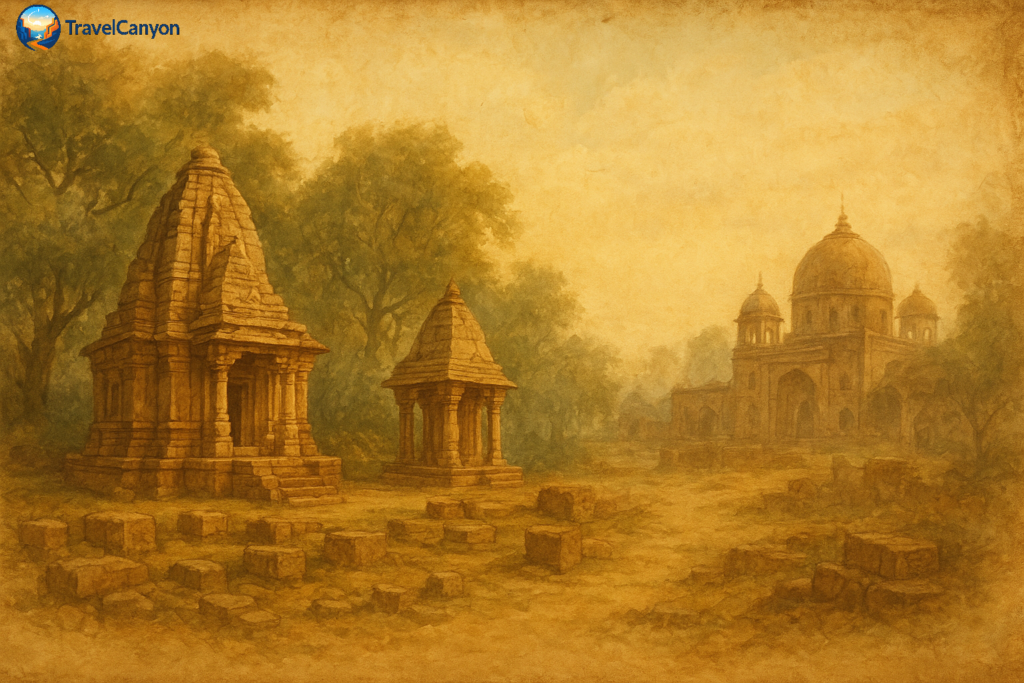
The history of Ayodhya temple at the Janmabhoomi site stretches far beyond the medieval era, rooted in early traditions and supported by references from travelers, chroniclers, and regional literature. While the exact architectural details of the earliest structures remain uncertain, multiple historical accounts suggest the presence of temples dedicated to Lord Ram at his birthplace as far back as the early centuries CE.
Ancient Indian texts and local chronicles mention shrines built by various rulers of the Gupta, Gahadavala, and other North Indian dynasties who patronized Hindu temples across the region. By the 11th and 12th centuries, Ayodhya had already become a flourishing pilgrimage center, with many rulers commissioning temples, ghats, and monasteries.
Several medieval travelers—both Indian and foreign—also documented the existence of temples in Ayodhya. Notably, accounts from visitors such as the Persian scholar Al-Biruni and later European travelers make mention of the city’s religious landscape. These records, together with archaeological remains discovered in later excavations, support the belief that a temple complex stood at the site traditionally worshipped as Shri Ram Janmabhoomi.
Medieval Conflicts and Structural Changes
The Ayodhya temple history underwent dramatic changes during the medieval period, a time marked by political upheavals and religious transformations. From the 12th century onward, North India experienced shifts in power as new dynasties established their rule. With these changes came clashes over sacred spaces, including the Janmabhoomi site.
Historical writings, regional folklore, and certain Mughal-era documents mention conflicts surrounding the temple structure. These references suggest periods of damage, reconstruction, and re-patronage. Later records indicate that a mosque—known as the Babri Masjid—was constructed at the site in the 16th century during the reign of Mughal emperor Babur. This architectural and religious transition marked the beginning of what would eventually become one of the most prolonged land and identity disputes in Indian history.
The medieval period thus represents a turning point in the history of Ayodhya temple, where centuries-old traditions intersected with significant political shifts. These developments laid the foundation for the complex historical narrative that would shape the Ram Janmabhoomi story for generations to come.
The Ram Janmabhoomi Dispute: Origins & Evolution
The roots of the Ram Janmabhoomi dispute trace back to the 16th century, during the establishment of Mughal rule in North India. Historical accounts, regional traditions, later court testimonies, and inscriptions referenced in legal proceedings have suggested that a mosque—later known as the Babri Masjid—was constructed in 1528 during the reign of Emperor Babur. Some historical sources and Hindu traditions hold the belief that this mosque was built after dismantling or altering an existing temple structure at the site considered to be the birthplace of Lord Ram. However, records from this period remain limited, leading to differing interpretations over the centuries.
Regardless of the exact sequence of events in the 1500s, by the late medieval period, the Janmabhoomi site had become an overlapping religious space, with both Hindu and Muslim communities maintaining long-standing associations with the area. This early contestation formed the foundation of the dispute that would evolve significantly over time.
| Category | Details |
|---|---|
| Location | Ayodhya, Uttar Pradesh, India |
| Architecture Style | Nagara Style (North Indian Temple Architecture) |
| Deity | Bhagwan Shri Ram (Ram Lalla) |
| Height | Approx. 161 feet |
| Width | Approx. 235 feet |
| Floors | 3 |
| Construction Material | Pink Sandstone |
| Mandir Trust | Shri Ram Janmabhoomi Teerth Kshetra |
British Records & Colonial Era Conflicts
The conflict gained clearer historical documentation during the British colonial period. Administrative reports from the 18th and 19th centuries recorded recurring tensions between the two communities over the site. By the mid-1800s, disputes escalated into open conflict, prompting the British administration to intervene.
In 1859, colonial authorities constructed a fence to separate the inner and outer courtyards. Muslims continued offering prayers inside the mosque structure, while Hindus were permitted to worship in the outer courtyard. This arrangement, though temporary, established dual claims to the site and further embedded the divide. The British records from this time mark an important turning point in the evolution of the conflict, providing clearer evidence of the religious significance attributed to the Janmabhoomi site.
Rise of the Ayodhya Temple Movement
The early 20th century marked the beginning of organized efforts to assert religious claims over the location. Various political and cultural groups began advocating for the restoration of a temple at the birthplace of Lord Ram. These efforts intensified over decades and became part of the broader political timeline of Ram Mandir.
The late 20th century witnessed nationwide mobilization, mass gatherings, court interventions, and growing public involvement. The dispute eventually culminated in the Babri Masjid demolition in 1992, a pivotal and tragic moment that reshaped the national dialogue on Ayodhya. In the years that followed, the matter moved through prolonged legal scrutiny, archaeological surveys, and political negotiations.
This period laid the groundwork for the historic Supreme Court verdict that would ultimately resolve the land dispute and set the stage for the reconstruction of the Ram Mandir in the 21st century.
| Event | Date |
|---|---|
| Supreme Court Verdict | 9 November 2019 |
| Bhoomi Pujan | 5 August 2020 |
| Construction Start | 2020 |
| Pran Pratishtha Ceremony | 22 January 2024 |
| Expected Full Completion | 2025 |
Timeline: Key Events in the Ram Mandir Dispute
The timeline of the Ram Mandir dispute spans more than 150 years, shaped by legal battles, social movements, political shifts, and religious sentiment. Below is a chronological overview highlighting major historical events related to Ram Janmabhoomi and key phases in the court case.
1857–1949: Early Conflicts & Placement of Idols
After several decades of tensions between communities, the British administration documented repeated disputes at the Janmabhoomi site. In 1861–1862, the British erected a fence to separate Hindu and Muslim areas of worship, allowing each community limited access to different portions of the site. This arrangement continued for nearly a century.
A major turning point came on 22 December 1949, when idols of Lord Ram were found inside the central dome of the structure. While Hindu devotees considered this an act of divine manifestation, authorities treated it as a disputed incident. The site was locked, and the government declared it a “contested property,” setting the stage for future legal battles.
1950–1980: Early Court Cases & Status Quo Orders
The Ram Mandir court case summary begins formally during this period. In 1950, the first petitions were filed by Hindu plaintiffs seeking permission to worship the idols and maintain access to the site. A series of civil suits followed, with courts passing interim orders to maintain the status quo.
In 1959, the Nirmohi Akhara filed a claim seeking management rights over the Janmabhoomi site. In 1961, the Sunni Waqf Board filed a counter-claim asserting ownership over the structure. Throughout the 1960s and 1970s, the dispute remained unresolved, as the legal process moved slowly.
1984–1992: Rise of the Ram Mandir Movement & Demolition
The dispute gained national prominence in the 1980s when several political and cultural groups formed committees to advocate for building a Ram temple at the Janmabhoomi site. Mass rallies, religious marches, and widespread mobilization marked this period.
On 6 December 1992, the Babri Masjid was demolished by large crowds, leading to nationwide unrest. This event dramatically reshaped public discourse and intensified the urgency for judicial intervention.
1993–2010: Court Proceedings & Archaeological Surveys
After the demolition, the central government acquired the disputed land and referred the matter to the courts. From the late 1990s to the 2000s, the Allahabad High Court conducted extensive hearings and reviewed archaeological evidence.
On 30 September 2010, the Allahabad High Court verdict ordered a three-way division of the land between the Sunni Waqf Board, Nirmohi Akhara, and the party representing the birthsite (Ram Lalla Virajman). However, all parties appealed the decision.
| Feature | Description |
|---|---|
| Garbh Griha | Houses the idol of Balak Ram Lalla |
| Total Pillars | 392 intricately carved pillars |
| Main Doors | Crafted in teak with gold plating |
| Mandap Design | Inspired by classical Nagara carvings |
| Pathway | 732-meter long Parikrama pathway |
| Materials Used | Bansi Paharpur sandstone, granite foundation |
2019: Supreme Court Verdict
On 9 November 2019, the Supreme Court verdict resolved the case by granting the entire disputed land to a trust for the construction of the Ram Mandir and allocating an alternate five-acre plot to the Sunni Waqf Board. This landmark judgment ended decades of dispute and paved the way for the construction of the modern temple.
Ram Mandir Construction: Timeline & Architecture
The Ram Mandir construction timeline officially began after the formation of the Shri Ram Janmabhoomi Teerth Kshetra Trust in early 2020. The groundbreaking Bhoomi Pujan, performed on 5 August 2020, marked the ceremonial beginning of the reconstruction of the sacred site. This event symbolized the start of a new era in Ayodhya’s spiritual resurgence and laid the foundation for how Ayodhya Ram Mandir was reconstructed after centuries of historical complexity.
Following the Bhoomi Pujan, extensive groundwork began, including soil testing, geological studies, and structural planning. In 2021, engineers initiated the construction of a robust foundation using layers of granite, ensuring long-term durability. Overlaid with reinforced stone pillars, the base was designed to withstand heavy structural loads and natural forces, reflecting modern engineering blended with ancient aesthetics.
| Aspect | Importance |
|---|---|
| Spiritual Symbol | Represents faith and devotion of Hindus |
| Historical Value | Connects to Ramayana, birthplace of Shri Ram |
| Unity Message | Symbol of cultural identity & harmony |
| Pilgrimage Boost | Expected to attract millions annually |
By 2022 and 2023, the mandir’s structural rise gained momentum. The ground floor, consisting of mandapas, intricately carved pillars, and the circumambulatory path, took shape. Artisans across India contributed carvings in pink sandstone from Rajasthan. By late 2023, the construction advanced into the second and third floors, completing the main sanctum (Garbhagriha) and placing the idol of the child form of Lord Ram (Ram Lalla).
By early 2024, the final structure—featuring grand stairways, mandapas, and the central shikhara—reached completion, marking one of the largest temple construction efforts in modern India.
Architectural Design & Symbolism
The Ram Mandir architecture reflects the grand traditions of the Nagar-style temples of North India, known for their towering shikharas, symmetrical carvings, and sacred geometry. Designed by renowned architect Chandrakant Sompura and his team, the temple spans over 2.7 acres, using more than 392 pillars and 5 domes crafted from high-quality sandstone.
Each pillar and wall features carvings depicting episodes from the Ramayana, celestial motifs, and symbolic patterns. The temple follows Vastu Shastra principles, ensuring harmony with cosmic energies. The sanctum is designed to allow natural sunlight to illuminate the idol of Ram Lalla on certain days of the year, symbolizing divine presence.
Artisans from Rajasthan, Gujarat, Uttar Pradesh, and Karnataka played vital roles in stone carving, woodwork, and ornamental detailing. The use of traditional craftsmanship combined with advanced structural technology ensures longevity without using iron or steel, staying true to ancient temple-building methods.
Together, the temple’s construction and design reflect devotion, cultural heritage, and the culmination of centuries of belief, making the Ram Mandir a monumental symbol of faith and architectural excellence.
| Impact Area | Effect |
|---|---|
| Domestic Tourism | Rapid increase in pilgrims |
| International Visitors | Surge in Hindu diaspora travel |
| Local Employment | Thousands of jobs generated |
| Ayodhya Development | Airports, hotels, expressways upgraded |
| Economy | Strong boost to local businesses and hospitality |
Ram Mandir Inauguration: A Historic Moment
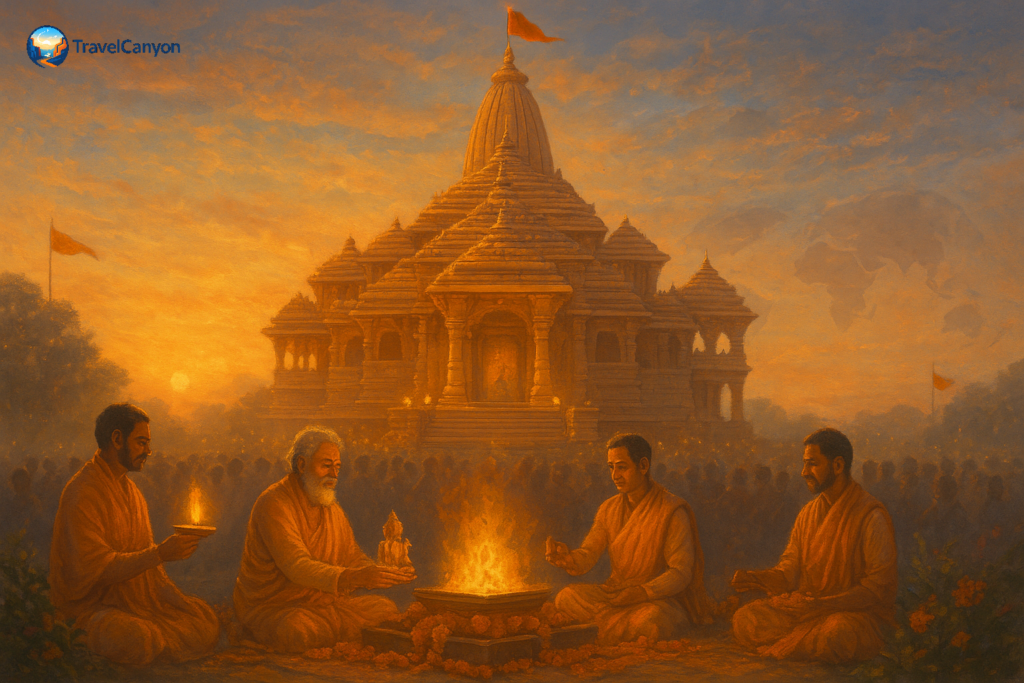
The Ram Mandir inauguration on 22 January 2024 marked one of the most significant cultural and religious events in modern Indian history. Millions across India and the global Hindu community tuned in to witness the Pran Pratishta ceremony of Ram Lalla, the child form of Lord Ram, installed in the beautifully crafted Garbhagriha of the newly constructed temple.
The event was attended by spiritual leaders, scholars, artisans, and dignitaries, symbolizing the culmination of centuries of faith, devotion, and historical developments surrounding the Ram Janmabhoomi site. Vedic rituals were performed by renowned priests, adhering to ancient temple traditions. The sacred moment, broadcast live worldwide, carried emotional resonance for many devotees who viewed it as the fulfillment of a long-awaited spiritual milestone.
The ceremony not only celebrated the temple’s completion but also honored the craftsmen, engineers, and contributors who played crucial roles throughout the construction process.
Global Reactions & Cultural Significance
The inauguration sparked widespread reactions across the world, drawing attention from international media, cultural organizations, and diaspora communities. Temples and Hindu communities in various countries organized special prayers, cultural programs, and live screenings, reflecting the global spiritual connection to Ayodhya.
The significance of Ram Mandir extends far beyond religious devotion. For many, it represents cultural continuity, identity, and the preservation of India’s civilizational heritage. The temple stands as a symbol of unity and hope, inviting people to revisit the values embodied by Lord Ram—dharma, compassion, and righteousness.
The inauguration also boosted Ayodhya’s prominence as a global spiritual destination, leading to major cultural, infrastructural, and tourism developments in the region. As a historic moment, the 2024 inauguration reaffirmed Ayodhya’s enduring place in India’s cultural imagination and marked the beginning of a new chapter in the temple’s legacy.
The Ram Mandir: A Symbol of Faith, Culture & Collective Identity
The cultural importance of Ram Mandir extends far beyond its physical structure—it represents a deep spiritual connection rooted in centuries of devotion, tradition, and cultural memory. For Hindus, Ayodhya is revered as the birthplace of Lord Ram, an embodiment of righteousness, virtue, and ideal kingship. The temple symbolizes the triumph of dharma and is seen as a sacred reminder of values central to the Hindu faith and Ram Janmabhoomi, including truth, discipline, compassion, and devotion.
Socially, the Ram Mandir serves as a powerful cultural anchor, influencing rituals, festivals, and storytelling traditions. Celebrations like Ram Navami, Diwali, and the Ramayana recitals (Katha and Ramlila) draw renewed inspiration from the temple’s legacy. The reconstruction of the mandir has also rekindled interest in classical arts, temple architecture, and Sanskrit traditions, integrating heritage with modern identity. Ayodhya’s transformation into a vibrant cultural center reinforces the temple’s role in shaping collective memory and national heritage.
On a global scale, the Ram Mandir resonates strongly with the Hindu diaspora. Across continents—from the United States to Southeast Asia—communities organized prayer gatherings, discussions, and cultural events to mark significant milestones in the temple’s development. For many, the mandir symbolizes belonging and connection to ancestral roots, strengthening cultural identity across generations. It stands as a spiritual touchstone that unites Hindus worldwide, bridging geographic distances through shared tradition.
Ultimately, the cultural, social, and religious significance of the Ram Mandir lies in its ability to inspire devotion, foster unity, and preserve one of the most cherished aspects of India’s civilizational heritage. Its presence in Ayodhya reflects not only a sacred past but also the continuing relevance of Lord Ram’s ideals in shaping contemporary cultural life.
Ram Mandir: Past vs Present
The Ram Mandir past and present reflects a journey that spans thousands of years, blending mythology, history, devotion, conflict, and cultural revival. In ancient times, Ayodhya was revered as the birthplace of Lord Ram, described in the Valmiki Ramayana as a prosperous kingdom filled with spiritual energy and dharma. The earliest references to a shrine at Ram Janmabhoomi come from Hindu scriptures and local traditions that preserved the sanctity of the site.
During the medieval era, political changes impacted Ayodhya’s religious landscape. Historical accounts and cultural memories suggest that the original temple was replaced, marking the beginning of a long-standing societal and emotional wound. For centuries, the site remained a focal point of faith, pilgrimage, and cultural identity, even as its physical form changed.
The dispute-era, stretching across the 19th and 20th centuries, transformed Ayodhya into a national conversation. Court documents, archaeological findings, and social movements kept the Ram Mandir story from ancient to modern times alive in public memory. The legal resolution in 2019 marked the end of a complex chapter.
Today’s modern-day Ayodhya stands transformed—spiritually, culturally, and architecturally. The newly built Ram Mandir symbolizes unity, restoration, and the fulfillment of collective belief. Its reconstruction is seen as more than an architectural achievement; it represents the healing of historical narratives and the resurgence of timeless devotion. The Ram Mandir now stands as a bridge between India’s ancient heritage and its modern aspirations.
Interesting Facts About Ram Mandir
The Ayodhya temple is not only a spiritual landmark but also an architectural marvel. Among the most fascinating Ram Mandir facts is its design based purely on traditional Nagara-style architecture, avoiding the use of steel or iron for structural integrity. The temple stands on a massive stone foundation created using modern engineering techniques alongside ancient principles, ensuring it lasts for centuries. Crafted from pink sandstone sourced from Rajasthan, the structure is designed to resonate with sacred geometry and Vedic proportions.
Religiously, the temple holds unparalleled significance for millions of devotees worldwide. It marks the birthplace of Lord Ram, a central figure in Hindu dharma, and symbolizes the triumph of truth and righteousness. The Pran Pratishta ceremony of 2024 elevated the temple into a vibrant spiritual hub, drawing attention from global Hindu communities.
For visitors, the Ram Mandir complex offers expansive pathways, detailed carvings, and areas dedicated to spiritual reflection. Facilities including digital kiosks, crowd-management systems, and spacious viewing corridors aim to enhance the pilgrimage experience. With its blend of devotion, history, and architectural brilliance, the temple promises to be one of India’s most iconic cultural destinations.
Conclusion
The journey of the Ram Mandir—from ancient reverence to medieval upheavals, from centuries of dispute to its present-day renaissance—reflects India’s resilient spirit. Rooted in thousands of years of faith and tradition, the site has stood as a symbol of devotion to Lord Ram and a reminder of the cultural depth of Hindu civilization. Its reconstruction marks not just the building of a temple but the restoration of a long-cherished heritage.
Today, the Ram Mandir stands as a beacon of unity, bringing together diverse communities in shared pride and spiritual harmony. It embodies the values of faith, perseverance, and cultural continuity. As devotees visit Ayodhya from across the world, the temple reinforces the idea that India’s cultural identity is shaped by both its history and its timeless devotion.
Ultimately, the Ram Mandir represents a powerful historical triumph—a bridge between the past and the present, reconnecting modern India with its ancient roots. It marks a renewed era of spiritual and cultural revival, inspiring future generations to honor and preserve their heritage.
FAQs About Ram Mandir
1. When was the Ram Mandir built?
The modern Ram Mandir construction began after the 2019 Supreme Court verdict, with the Bhoomi Pujan performed on 5 August 2020. The first phase was completed in January 2024, when the Pran Pratishta ceremony was held. Ongoing work continues for additional complexes, pilgrim facilities, and decorative elements.
2. What is the significance of Ram Janmabhoomi?
Ram Janmabhoomi is believed to be the birthplace of Lord Ram, one of the most revered deities in Hinduism. The site holds deep cultural and spiritual meaning as it represents dharma, devotion, and centuries of faith in the Ramayana tradition.
3. What did the Supreme Court decide about Ayodhya?
In November 2019, the Supreme Court awarded the disputed land to a trust to build the Ram Mandir, acknowledging evidence of a non-Islamic structure beneath the demolished Babri Masjid. It also directed the government to allocate 5 acres of land elsewhere in Ayodhya for a mosque.
4. What is special about Ram Mandir architecture?
The temple follows the Nagara style of architecture, using no steel or iron in its structure. Built with pink sandstone, it incorporates sacred geometry, intricate carvings, and traditional Vastu principles. The design blends historical aesthetics with modern engineering for longevity.
5. Is Ram Mandir open to visitors?
Yes. After the Pran Pratishta in 2024, the temple opened for public darshan with organized queues, security, and visitor facilities.
6. Who designed the Ram Mandir?
The original design was created by Sompura architects, a renowned family with centuries-old expertise in temple craftsmanship.
7. How large is the Ram Mandir complex?
The complex spans 70+ acres, featuring the main temple, gardens, pilgrim amenities, and cultural areas that will develop further in upcoming construction phases.